
Ky-Mani Marley’s Love and Energy Is Built for the Full Spin
Ten years after his last full-length project, Ky-Mani Marley returns with a warm, soulful and remarkably cohesive album that rewards more than a casual listen.
Artist: Ky-Mani “Maestro” Marley
Album: Love & Energy
Released: August 28, 2026
Length: 16 tracks, 56 minutes
Label: Konfrontation Muzik Group / DubShot Records
YouTube Music: CLICK HERE

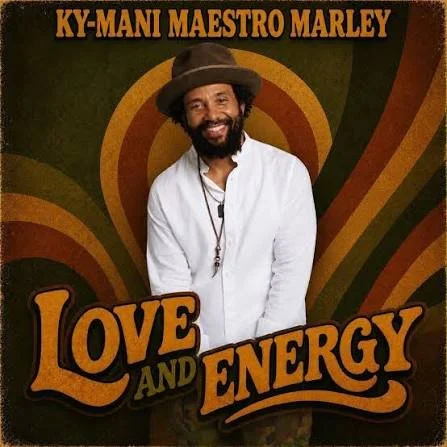





Singles get attention. Albums reveal the artist.
That belief is at the heart of Wax and it is exactly why Ky-Mani Marley’s Love and Energy deserves to be heard from the first beat of “New Creature” to the final notes of “Send Down the Rain.” This is not an album that gives up everything in a 30-second clip. Its appeal accumulates: one rhythm, one lyric and one carefully placed change of mood at a time.
Across 16 tracks and 56 minutes, Ky-Mani moves through roots reggae, R&B, soul, acoustic pop and flashes of world music without making the album feel scattered. The sound changes, but the spirit stays steady. That is the achievement. Love & Energy feels broad without losing its center and relaxed without becoming passive.
It is also Ky-Mani’s first full-length album in roughly a decade. That time seems to have sharpened his instincts rather than burdened the project with the need to make a grand comeback statement. He does not sound like an artist trying to prove he still belongs. He sounds like an artist who knows exactly who he is.
Before the needle drops: Who is Ky-Mani Marley?
The Marley name opens doors, but it also creates a nearly impossible standard. Every son and daughter of Bob Marley who makes music is inevitably heard in conversation with that legacy. Ky-Mani has spent his career respecting the inheritance without allowing it to become a cage.
Born in Falmouth, Jamaica, in 1976 to Bob Marley and Jamaican table-tennis champion Anita Belnavis, Ky-Mani moved to Miami as a child. Sports were his first passion. His mother encouraged the artistic side by arranging lessons in piano, guitar and trumpet. That early combination— Jamaican roots, Miami energy, athletic discipline and musical curiosity—helps explain why he has never remained inside one genre for long.
Even his East African name, commonly translated as “adventurous traveler,” feels fitting. Since his 1996 debut, Like Father Like Son, he has moved among roots reggae, dancehall, hip-hop, R&B and rock. His 2001 album Many More Roads earned a Grammy nomination, while his acting roles in the Jamaican cult classic Shottas and the romantic drama One Love introduced another side of his creative identity.
The useful thing to know before pressing play, however, is simple: Ky-Mani Marley is not merely carrying a family sound forward. He has built a sound elastic enough to carry his own life.
The first impression
My first reaction to Love & Energy was uncomplicated: I thoroughly enjoyed it from beginning to end.
This is warm-weather music, but not disposable summer music. I can imagine it playing beside a pool at home, with small plates, good cocktails and people you actually like. It creates an atmosphere without disappearing into it. I can also imagine putting it on during a long drive, where the speakers and the open road give you enough space to hear the structure, sequencing and lyrics more closely.
In either setting, the album can stay on repeat. Its 16 tracks are varied enough to keep the ear interested, yet connected enough to preserve the mood. It does not lurch from genre to genre in search of attention. Instead, it makes subtle adjustments— more roots here, more soul there, an acoustic turn, a fuller world-beat lift— while remaining recognizably Ky-Mani.
For listeners who do not regularly explore reggae, there are several points of entry. If you respond to the genre-crossing storytelling of Shaboozey, the open-road intimacy of Zach Bryan, the melodic sensitivity of James Bay or the rootsy experimentation of Ben Harper, there is something here for you. A broader shorthand might be Chris Stapleton’s grain, Ed Sheeran’s accessibility and Peter Gabriel’s world-minded ambition carried by reggae, R&B and soul rhythms.
Those comparisons are invitations, not equations. Ky-Mani does not sound like any one of those artists. The point is that Love & Energy reaches beyond a rigid definition of reggae without diluting the music at its foundation.
What holds the album together
The album’s title provides its organizing idea. Love is the subject, but energy is the movement.
Ky-Mani explores love as romance, compassion, kinship, resilience and spiritual responsibility. That gives the album room to move from the attraction of “Miss Electric” to the social weight of “Poor Man’s Cry,” from the collaborative uplift of “One Family” to the searching atmosphere of “When the World.” The subjects change, but the album keeps returning to connection: what draws people together, what pulls them apart and what might help them endure.
Musically, Love & Energy weaves acoustic-pop storytelling, raw roots grit and expansive world-beat production into one continuous experience. The songs rarely rush. Much of the album feels as if it moves around the pace of a resting heartbeat— roughly 60 to 90 beats per minute. That unhurried pulse gives the words room to land and the bass lines room to breathe.
Slow, however, does not mean sleepy. The album maintains motion through texture: a guitar phrase, a vocal entrance, a shift in percussion, a guest artist changing the temperature of a song. The energy is controlled rather than forced.
The production and the lost art of sequencing
The production is contemporary, polished and consistent across the album. After repeated listens, I am hard-pressed to identify a track that feels carelessly finished or sonically out of place. But the production’s greatest success may be what it does not do. It never overwhelms Ky-Mani’s voice or sands away its natural grain.
That voice remains the anchor: weathered, soulful and immediately human. The arrangements know when to frame it with space and when to surround it with fuller instrumentation. The record can feel intimate in one moment and communal in the next.
Just as important is the track order. I am a stickler for sequencing because an album should be more than a folder containing songs. It should create an experience. Whether every transition here was exhaustively planned or arrived by instinct, Love & Energy is arranged with an impressive sense of flow.
“New Creature” opens with a recognizable one-drop feel and establishes the album’s heartbeat immediately. From there, the title track widens the circle with Lutan Fyah and Iba Mahr. “Miss Electric” changes the emotional color; “All This Love” and “City Views” continue the movement without repeating the same idea. Later, the two brief “Reflection” interludes create breathing spaces before the album grows heavier and more collaborative in its final stretch.
That variety is why 56 minutes never feels excessive. Ky-Mani mixes reggae, R&B and soul in changing proportions, making each track distinct while keeping all of them inside the same emotional world. Nothing falls out of character. The album knows its lane, but it refuses to drive in a straight line.
The standout moments
Two moments first pulled me deeper into the record.
The first is the opening of “New Creature.” There is no long runway and no uncertainty about the atmosphere Ky-Mani wants to create. The one-drop rhythm arrives, the body recognizes it and the album is underway. As an opener, it performs the essential job: it makes you want to hear what comes next.
The second is “Poor Man’s Cry,” one of the album’s deepest and most emotional songs. Its soulful weight recalls “Dear Dad” from The Journey— not because the two songs tell the same story, but because both reveal what Ky-Mani can do when the performance feels unguarded. He does not need a guest appearance or a crowded arrangement. The feeling is the feature.
“Poor Man’s Cry” also proves why this album should not be reduced to pleasant-vibe reggae. There is warmth throughout Love & Energy, but warmth is not the same as weightlessness. Beneath the inviting grooves are questions of hardship, responsibility, family and survival.
My three essential tracks
Ask me tomorrow and this list may change. That is usually a good sign.
“Miss Electric”
An immediate charmer. The track shows Ky-Mani’s melodic side and adds a spark of romance without becoming sugary. It is accessible enough to pull in a new listener and textured enough to survive repeat plays.
“New Creature”
The ideal opening statement. It connects the album to reggae tradition while sounding fully present. More than a strong song, it is the doorway into the record.
“Poor Man’s Cry”
The emotional center of the album. This is where the voice, message and restrained production meet most powerfully. If someone assumes Love & Energy is designed only for easy listening, play this track and let it complicate that impression.
Three collaborations worth another spin
The guest performances deserve their own category because they show Ky-Mani operating in conversation with reggae’s larger family tree.
“When the World,” featuring Andrew Tosh and Anthony B, carries generational resonance without leaning on lineage as a novelty. “One Family,” featuring Bugle, turns the album’s central idea of connection into a direct communal statement. The title track (see video at the top), featuring Iba Mahr and Lutan Fyah, makes the album’s philosophy explicit: love is not simply a mood here; it is a force.
These collaborations expand the record, but they do not rescue or dominate it. Ky-Mani’s solo performances are strong enough to stand beside them. That balance matters. The guest list feels curated around the album’s ideas rather than assembled to manufacture attention.
The full-spin verdict
Stream it. Save it. Buy it. And if a vinyl edition becomes available, give the album the physical format its sequencing deserves.
Most importantly, listen to it at full volume— through proper speakers, good earbuds or your car stereo. Do not reduce it to anonymous background music in a fashionable hotel lobby. Love and Energy is easy to enjoy casually, but it becomes more rewarding when you give it your attention.
This is not a radical reinvention of Ky-Mani Marley. It is something more satisfying: a confident refinement of the qualities that have always distinguished him. The roots are intact. The borders remain open. The voice carries experience. And after ten years between albums, he has returned with a record that feels neither hurried nor overworked.
Love and Energy does what a strong album should do. It establishes a world, invites you inside and gives you more to notice each time you return.
Wax rating: Full-spin worthy.
Now it is your turn: Which three tracks would make your essential list today? Which one do you expect to change tomorrow? Share your full-spin verdict, then stay with Wax for more artists, albums and reggae stories worth hearing beyond the single.